 Laser Diode Manufacturer











NEWS
High quality high performance excellent service
Search productSearch post
High quality high performance excellent service
The modern industrial landscape relies increasingly on the precision delivery of light. In the hierarchy of photonics, the fiber coupled laser diode stands as a pinnacle of optoelectromechanical integration. Unlike direct-emitting diodes, which project light into free space with high divergence and asymmetry, a fiber laser module encapsulates complex beam-shaping physics to deliver a circular, homogenized, and flexible beam. For the procurement engineer or system designer, the challenge lies in navigating the gap between theoretical specifications and the harsh realities of long-term thermal and mechanical degradation.
To understand the core of a diode laser module, one must first address the concept of Etendue—the “geometric extent” of the light. In any passive optical system, the Etendue (the product of the source area and its solid angle) cannot be decreased. The semiconductor junction of a high-power laser diode typically measures 1 μm in height (fast axis) and 100 μm to 200 μm in width (slow axis).
The fast axis, being diffraction-limited, exhibits a divergence of $30^\circ$ to $40^\circ$, while the slow axis, being multi-mode, has a lower divergence of $6^\circ$ to $10^\circ$ but a much larger emitting area. The engineering goal of a fiber coupled laser is to map this highly rectangular and astigmatic emission into the circular core of an optical fiber (typically 105 μm or 200 μm) without exceeding the fiber’s Numerical Aperture (NA).
High-efficiency coupling is achieved through a sequence of micro-lenses. The Fast Axis Collimator (FAC) is the most critical component. Due to the extreme divergence, the FAC must be an aspheric lens with a high refractive index (typically $n > 1.8$), positioned at a working distance often less than 100 μm from the diode facet. Any sub-micron tilt in the FAC results in “pointing error,” which manifests as lost power at the fiber entry point and localized heating that can destroy the module.
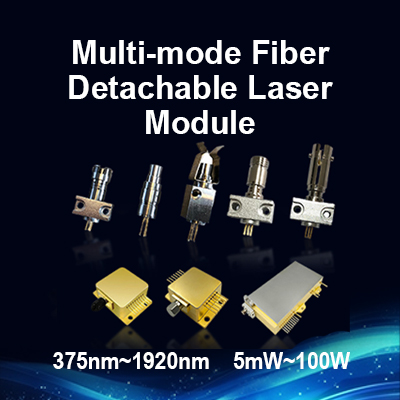
A diode laser fiber system is essentially a heat engine with ~50% efficiency. The remaining 50% of electrical input is converted into heat at the PN junction. In high-power applications, such as a 200W fiber laser module, 200W of waste heat must be dissipated from a microscopic footprint.
The primary failure mode for high-power diodes is Catastrophic Optical Mirror Damage (COMD). This occurs when the temperature at the facet rises high enough to melt the semiconductor material. To prevent this, the heat-sinking path must be optimized for low thermal resistance ($R_{th}$).
Beyond basic emission, several advanced technologies define the quality of a modern diode laser module:
The following table compares the typical technical requirements for different scales of fiber coupling. Understanding these trade-offs is essential for selecting the right architecture for a specific industrial application.
| Technical Parameter | Single Emitter Module | Multi-Emitter (Bar) Module | Multi-Single Emitter Module |
| Output Power Range | 1W – 30W | 60W – 1000W | 30W – 500W |
| Fiber Core Diameter | 50 µm / 105 µm | 400 µm / 600 µm | 105 µm / 200 µm |
| Brightness (W/cm²·sr) | Very High | Low to Medium | High |
| Thermal Complexity | Low (Passive) | High (Micro-channel) | Medium (Conduction) |
| Alignment Tolerance | ± 0.5 µm | ± 2.0 µm | ± 1.0 µm |
| Failure Risk | Single Point | Entire Bar (Series) | Graceful Degradation |
| Typical Application | Fiber Laser Seeding | Plastic Welding / Pumping | Medical / Metal Processing |
Customer Background:
A manufacturer of high-power continuous-wave (CW) fiber lasers for metal cutting was facing significant efficiency drops in their final systems. Despite using 200W pump modules, the final output was 15% lower than theoretical models suggested.
The Technical Challenge:
The customer was using 976nm fiber laser module units without wavelength stabilization. The absorption peak of Ytterbium (the active medium in the fiber laser) is extremely narrow at 976nm (only ~2nm wide). As the pump diodes warmed up during operation, their wavelength shifted to 982nm, moving out of the absorption band and causing “pump through”—where unabsorbed pump light reaches the end of the system without contributing to the laser gain.
Technical Parameter Adjustments:
Quality Control (QC) and Testing:
The modules underwent a 100-cycle thermal shock test from -20°C to +70°C to ensure the VBG and micro-optics alignment remained stable. We used a spectral analyzer to verify that the FWHM (Full Width at Half Maximum) remained below 0.7nm across the entire current range (2A to 22A).
Conclusion:
By stabilizing the wavelength, the customer’s system efficiency increased by 18%, and the thermal load on the gain fiber was significantly reduced. This allowed them to shrink their cooling unit size, reducing the overall system cost by 10% despite the higher initial cost of the VBG-stabilized modules.
From the perspective of a diode laser module manufacturer, the price is often a reflection of the “Yield of Precision.” A module with a 0.15 NA is significantly harder to produce than one with a 0.22 NA because the alignment tolerances are exponentially tighter.
For the buyer, choosing a lower-cost fiber coupled laser often introduces hidden costs:
1. What is the difference between “Multi-mode” and “Single-mode” fiber coupling?
Single-mode fiber coupling involves a core diameter of ~9 μm and is extremely difficult for high-power diodes due to the M² mismatch. Most fiber coupled laser diode units for industrial use are multi-mode (105 μm or 200 μm), providing a balance between power and beam quality.
2. How does back-reflection damage the laser diode?
When processing materials like aluminum or copper, light can reflect back into the fiber. The internal lenses focus this reflected light back onto the diode facet. Even a small amount of reflected energy can create a power density high enough to cause COMD (Catastrophic Optical Mirror Damage).
3. Why is 976nm better than 915nm for pumping fiber lasers?
976nm has a much higher absorption cross-section in Ytterbium-doped fibers, allowing for shorter gain fibers and higher efficiency. However, it requires a fiber laser module with wavelength stabilization (VBG) because the absorption peak is very narrow.
4. What is “Active Alignment” in manufacturing?
Active alignment is the process where the laser diode is powered on during the assembly of the micro-optics. The output is monitored in real-time by sensors to find the “peak” efficiency before the lenses are permanently laser-welded or soldered into place.
5. How does humidity affect a diode laser module?
If a module is not hermetically sealed, humidity can condense on the cooled diode facet. When the laser is turned on, this moisture interacts with the high-intensity photons, leading to rapid facet oxidation and failure.
In the competitive world of aesthetic medicine—specifically hair removal and vascular treatments—equipment downtime is the silent killer of profitability. For years, the industry standard was the heavy, water-cooled vertical stack handpiece. These...
View detailsIn the hierarchy of photonic components, the 1064nm single mode fiber coupled laser diode occupies a unique position. While multi-mode diodes are valued for their raw power, single-mode modules are the architects of precision. The fundamental valu...
View detailsThe transition from direct-diode emissions to fiber-delivered delivery systems represents one of the most significant evolutions in photonics. For system integrators and manufacturers, the selection of a fiber coupled laser diode is not merely a p...
View detailsThe 980nm single mode fiber coupled laser diode serves as the heartbeat of modern optical communication and precision medical instruments. While other wavelengths are chosen for their specific absorption in tissues or transparency in silica, 980nm...
View details