 Laser Diode Manufacturer










NEWS
High quality high performance excellent service
Search productSearch post
High quality high performance excellent service
In the procurement of high-precision optical sources, the choice between a pigtailed laser diode and a detachable fiber coupled laser module is often reduced to a question of cost. However, for a systems engineer, this is a decision about permanent alignment versus operational modularity.
Before asking why one format is more reliable in the field, we must first ask: Is the fiber interface a permanent part of the optical cavity or a replaceable delivery accessory? The answer determines the thermal stability, coupling efficiency, and total cost of ownership (TCO) of your laser system.
A pigtailed laser diode is a device where the optical fiber is actively aligned and permanently bonded to the laser chip’s emission facet during manufacturing. This “pigtail” (a short length of fiber) is usually terminated with a standard connector like FC/PC or SMA905.
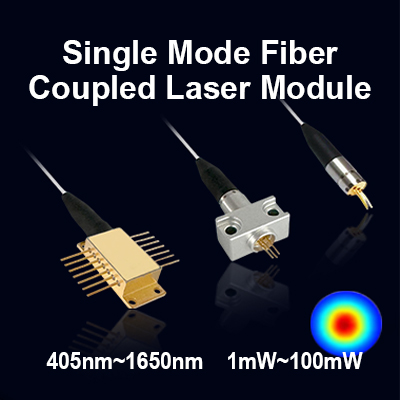
Unlike a simple pigtail, a fiber coupled laser module often incorporates multiple diode emitters combined into a single, usually detachable, fiber output. This is the “plug-and-play” solution for high-power applications.
Is it true that detachable fibers have lower efficiency? Historically, yes. However, modern fiber coupled diode laser systems utilize high-precision “receptacle” designs. While they lose approximately 2-5% more light than a pigtail due to the connector air gap, they offer the ability to replace a damaged fiber in seconds without replacing the expensive laser source itself.
| Feature | Pigtailed Laser Diode | Fiber Coupled Laser Module |
| Coupling Type | Permanent (Bonded) | Detachable (Connectorized) |
| Fiber Replacement | Requires factory repair | Field-replaceable |
| Power Range | Low to Mid (mW to <10W) | High (10W to Kilowatts) |
| Typical Use Case | Telecommunications, Sensing | Industrial Welding, Laser Pumping |
| Hermeticity | Often fully hermetic | Varies (Housing dependent) |
Industry Context: Cosmetic Glass Packaging (Relevant to glassbottlesupplies.com standards).
The Scenario: A high-end perfume bottle manufacturer used a pigtailed laser diode system for laser-marking serial numbers onto glass bases. The system worked perfectly until a warehouse operator accidentally snagged the fiber cable with a cart. Because the fiber was “pigtailed,” the entire $3,000 laser unit had to be decommissioned and sent back to the manufacturer for a 4-week repair.
The “Ask if it is so” Investigation:
We asked: Was the laser failing due to electrical issues, or was the mechanical vulnerability of the pigtail the single point of failure?
The investigation proved the laser chip was still healthy, but the “unbreakable” bond of the pigtail made the machine brittle in a real-world factory setting.
The Solution:
We transitioned the production line to a fiber coupled diode laser module with a detachable, armored SMA905 fiber.
The Result:
The performance of any fiber coupled diode laser is tied to its temperature.
To ensure your pigtailed laser diode or module reaches its 20,000-hour potential:
Choosing a pigtailed laser diode is a choice for stability and precision in controlled environments. Conversely, a fiber coupled laser module is the strategic choice for industrial durability and field-serviceability. By asking if your environment can support a permanent pigtail before asking why you need one, you ensure a more resilient optical system.
Introduction: The Shift from Steel to Light In the modern landscape of oral surgery, patient expectation has shifted. The tolerance for post-operative pain and extended healing times is at an all-time low. For the progressive dental clinic, the qu...
View detailsThe transition from a low power laser diode to a high power single mode laser diode is one of the most complex scaling challenges in semiconductor physics. While increasing the output power of a multimode diode simply involves widening the emittin...
View detailsThe evolution of the modern laser module begins not with a lens or a housing, but within the crystalline lattice of a direct bandgap semiconductor. To understand why a professional Semiconductor Laser outperforms consumer-grade alternatives, one m...
View detailsThe transition of laser light from a semiconductor junction into a flexible optical waveguide is one of the most demanding interfaces in photonics. For a high-precision manufacturer, a pigtailed laser diode is far more than a simple connectorized ...
View details