 激光二极管制造商










新闻
高品质 高性能 优质服务
搜索产品搜索帖子
高品质 高性能 优质服务
The transition of the 半导体激光器 from a fragile laboratory curiosity to the backbone of modern industrial and medical infrastructure is a triumph of materials science and optomechanical engineering. When an OEM engineer searches for a 激光出售, they are not merely purchasing a light source; they are investing in a “photon engine” where the spatial, spectral, and temporal properties of the light must be strictly governed by the intended application. A high-performance 激光模块 is the physical manifestation of this control, bridging the gap between raw semiconductor physics and real-world precision.
In the realm of 激光模块, power is often secondary to brightness. Brightness, or radiance, is defined as the optical power per unit area and unit solid angle. The fundamental limitation of an edge-emitting 半导体激光器 lies in its asymmetric emitting aperture. Typically, the active region is only 1-2 $\mu$m thick but can be hundreds of micrometers wide. This geometry leads to a diffraction-limited “fast axis” and a highly multi-mode “slow axis.”
The quality of the output beam is quantified by the $M^2$ factor (Beam Propagation Ratio). For a perfect Gaussian beam, $M^2 = 1$. However, a raw high-power diode may have an $M^2$ exceeding 20 in the slow axis. A professional 激光调制器 employs sophisticated micro-optics to transform this highly astigmatic output. The goal of advanced engineering is to preserve the “Lagrange Invariant” (the product of the beam waist and the divergence angle) while shaping the beam into a useful circular or square profile.
$$B = \frac{P}{A \cdot \Omega} \approx \frac{P}{\lambda^2 \cdot M_x^2 \cdot M_y^2}$$
In the formula above, $B$ represents brightness. It becomes clear that increasing power $P$ without controlling the beam quality $M^2$ results in a negligible gain in actual brightness, which is the parameter that determines how small a spot can be focused or how far a beam can travel with minimal divergence.
A 激光调制 (the Latin-rooted term for a standardized unit) must maintain sub-micron optical alignment across a wide range of operating temperatures and mechanical stresses. The choice of housing materials is a critical engineering decision that dictates long-term pointing stability.
Standard aluminum housings are common in low-cost 激光出售 listings, but they suffer from a high Coefficient of Thermal Expansion (CTE). In precision industrial sensing or medical surgery, a temperature shift of 10°C can cause a thermal expansion of several microns in an aluminum mount, sufficient to de-align a collimating lens and cause “beam walk.”
High-end 激光模块 utilize materials such as Kovar (a Nickel-Cobalt-Iron alloy) or Copper-Tungsten (CuW). These materials are chosen for their CTE match with the semiconductor die and the optical glass. By minimizing the CTE mismatch at the interface where the diode is bonded to the submount, engineers prevent “solder fatigue” and mechanical creep, ensuring the beam remains centered throughout the device’s 20,000-hour lifespan.
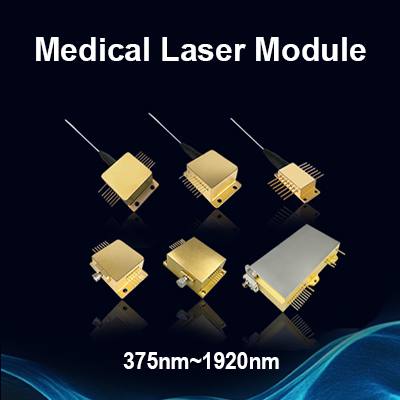
For industrial environments where oil mist, humidity, or corrosive gases are present, the packaging of the 半导体激光器 must be hermetic. This usually involves a TO-can or a Butterfly package with a gold-plated interior and a Nitrogen or Argon-purged atmosphere. If a module is not properly sealed, moisture can condense on the facets, leading to catastrophic optical damage (COD) or gradual degradation due to photo-oxidation.
The most common failure mode for a 激光调制器 is not wear-and-tear, but electrical overstress (EOS). Laser diodes are essentially high-speed LEDs with extremely low internal resistance. They are susceptible to nanosecond-scale current spikes.
A sophisticated 激光模块 incorporates a driver that can operate in either Automatic Current Control (ACC) or Automatic Power Control (APC) mode. In APC mode, a photodiode integrated within the module monitors the actual light output and adjusts the drive current in real-time to maintain a constant power level. This compensates for the natural decline in efficiency as the diode heats up.
However, the driver must also include “crowbar” circuits and soft-start mechanisms. When the power is first applied, the driver must ramp the current linearly to avoid $dV/dt$ spikes that can puncture the thin quantum well layers of the 半导体激光器.
The performance of 激光模块 varies significantly depending on the semiconductor material used. The following table provides a technical comparison of common semiconductor families used in industrial and medical modules.
| 材料系统 | Typical Wavelengths | 壁插效率 | 常见应用 | Technical Constraint |
| GaN (Gallium Nitride) | 405nm – 520nm | 20% - 30% | 3D Printing, Laser Display | High thermal density requires active cooling. |
| AlGaInP | 635nm – 670nm | 25% – 35% | Medical Alignment, Barcode | Highly sensitive to temperature (wavelength shift). |
| AlGaAs / GaAs | 780nm – 980nm | 45% – 60% | Pumping, Aesthetic Med | High power density; requires facet passivation. |
| InGaAsP / InP | 1310nm – 1550nm | 30% – 40% | Gas Sensing, LiDAR | Eye-safe but lower efficiency than GaAs. |
To fully understand the competitive landscape of 激光模块, three additional technical domains must be considered:
A manufacturer of high-power Ytterbium-doped fiber lasers for industrial cutting required a stable, high-brightness pumping source. The pump light needed to be delivered via a 105$\mu$m core fiber with a Numerical Aperture (NA) of 0.22.
The primary challenge was “Spectral Broadening.” As the pump power increases, the wavelength of the 半导体激光器 shifts and broadens. If the pump wavelength falls outside the absorption peak of the Ytterbium fiber (approx. 915nm ± 10nm), the efficiency of the entire system collapses, leading to excess heat and potential failure of the fiber laser.
The modules were subjected to a “Thermal Cycling” test, moving between -20°C and +60°C for 100 cycles to ensure the fiber-coupling alignment remained stable. Furthermore, a “Power Stability” test was conducted over 500 hours, with a requirement that the power fluctuation remain below 0.5% (Peak-to-Peak).
By utilizing a VBG-locked 激光模块, the client was able to maintain peak absorption efficiency regardless of ambient temperature changes. The high-brightness output allowed for a more compact fiber laser design, reducing the overall footprint of their industrial cutting machines by 20%. This case demonstrates that for high-power applications, the integration of optical feedback protection and spectral locking is essential for system reliability.
When procuring 激光模块 for OEM integration, the “lowest cost” option often hides significant technical debt. A professional evaluation should focus on:
The engineering team at 激光二极管-LD.com focuses on these quantifiable metrics rather than marketing hyperbole. By understanding the underlying physics of the 半导体激光器 and the engineering constraints of the 激光模块, buyers can make informed decisions that optimize for the “Total Cost of Ownership” rather than the initial purchase price.
Q1: Why does a Semiconductor Laser have a “threshold current”?
A: A laser requires “population inversion,” where more electrons are in the excited state than in the ground state. The threshold current is the point where the gain from stimulated emission exactly balances the internal losses and facet transmission. Below this current, the device acts as an inefficient LED.
Q2: What is the benefit of a “VBG-locked” laser module?
A: A Volume Bragg Grating (VBG) acts as an external frequency-selective mirror. It forces the laser modul to operate at a precise wavelength and significantly reduces the spectral shift caused by temperature changes, which is vital for pumping and spectroscopy.
Q3: How does the Numerical Aperture (NA) of a fiber affect laser module performance?
A: The NA represents the cone of light that a fiber can accept. If the Semiconductor Laser output is not perfectly collimated and focused within that NA, the “mis-matched” light will enter the fiber cladding instead of the core, causing the fiber jacket to melt at high powers.
Q4: Can these modules be used in vacuum environments?
A: Standard laser modules often use outgassing epoxies or greases. For vacuum compatibility, one must specify “space-grade” or “vacuum-compatible” construction, which uses low-outgassing adhesives and vented screw holes to prevent trapped air pockets.
在高风险的工业制造领域,精确度不仅关乎切割精度——更关乎数千小时内光束的稳定性。多年来,该行业一直依赖笨重的镜面传输系统或直接二极管阵列,这些方案...
查看详情现代激光模块的发展并非始于透镜或外壳,而是始于直接带隙半导体的晶格。要理解为什么专业半导体激光器的性能比消费级替代品更胜一筹,我们需要...
查看详情二十一世纪的工业格局以精密、高速和高效为特征。数十年来,这些需求一直依赖于笨重复杂的激光系统来满足,这些系统依赖于气体或固态介质。然而,一项不起眼、薄如晶圆的技术——激光器...
查看详情