 Laser Diode Manufacturer










NEWS
High quality high performance excellent service
Search productSearch post
High quality high performance excellent service
In the procurement of high-precision optical sources, the choice between a pigtailed laser diode and a detachable fiber coupled laser module is often reduced to a question of cost. However, for a systems engineer, this is a decision about permanent alignment versus operational modularity.
Before asking why one format is more reliable in the field, we must first ask: Is the fiber interface a permanent part of the optical cavity or a replaceable delivery accessory? The answer determines the thermal stability, coupling efficiency, and total cost of ownership (TCO) of your laser system.
A pigtailed laser diode is a device where the optical fiber is actively aligned and permanently bonded to the laser chip’s emission facet during manufacturing. This “pigtail” (a short length of fiber) is usually terminated with a standard connector like FC/PC or SMA905.
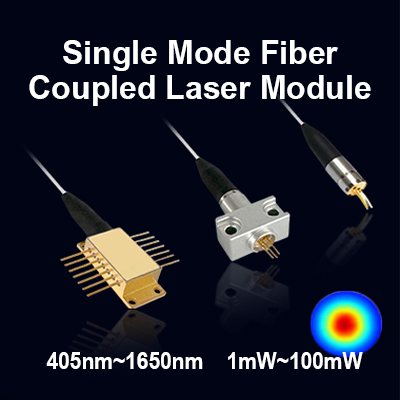
Unlike a simple pigtail, a fiber coupled laser module often incorporates multiple diode emitters combined into a single, usually detachable, fiber output. This is the “plug-and-play” solution for high-power applications.
Is it true that detachable fibers have lower efficiency? Historically, yes. However, modern fiber coupled diode laser systems utilize high-precision “receptacle” designs. While they lose approximately 2-5% more light than a pigtail due to the connector air gap, they offer the ability to replace a damaged fiber in seconds without replacing the expensive laser source itself.
| Feature | Pigtailed Laser Diode | Fiber Coupled Laser Module |
| Coupling Type | Permanent (Bonded) | Detachable (Connectorized) |
| Fiber Replacement | Requires factory repair | Field-replaceable |
| Power Range | Low to Mid (mW to <10W) | High (10W to Kilowatts) |
| Typical Use Case | Telecommunications, Sensing | Industrial Welding, Laser Pumping |
| Hermeticity | Often fully hermetic | Varies (Housing dependent) |
Industry Context: Cosmetic Glass Packaging (Relevant to glassbottlesupplies.com standards).
The Scenario: A high-end perfume bottle manufacturer used a pigtailed laser diode system for laser-marking serial numbers onto glass bases. The system worked perfectly until a warehouse operator accidentally snagged the fiber cable with a cart. Because the fiber was “pigtailed,” the entire $3,000 laser unit had to be decommissioned and sent back to the manufacturer for a 4-week repair.
The “Ask if it is so” Investigation:
We asked: Was the laser failing due to electrical issues, or was the mechanical vulnerability of the pigtail the single point of failure?
The investigation proved the laser chip was still healthy, but the “unbreakable” bond of the pigtail made the machine brittle in a real-world factory setting.
The Solution:
We transitioned the production line to a fiber coupled diode laser module with a detachable, armored SMA905 fiber.
The Result:
The performance of any fiber coupled diode laser is tied to its temperature.
To ensure your pigtailed laser diode or module reaches its 20,000-hour potential:
Choosing a pigtailed laser diode is a choice for stability and precision in controlled environments. Conversely, a fiber coupled laser module is the strategic choice for industrial durability and field-serviceability. By asking if your environment can support a permanent pigtail before asking why you need one, you ensure a more resilient optical system.
The journey of a high-performance semiconductor light source begins long before the final assembly in a China laser diode factory. It starts with the calculation of the Schrödinger equation within the context of a periodic crystal potential. To fu...
View detailsThe transition of surgical interventions from gas lasers (like CO2) and solid-state lasers (like Nd:YAG) to semiconductor-based medical diode laser technology represents one of the most significant shifts in clinical engineering. However, for the ...
View detailsIn the realm of Directed Energy Deposition (DED) and Laser Cladding, the industry has hit a materials wall. While standard infrared (IR) sources handle steel and titanium effortlessly, the surge in demand for copper and gold alloys—driven by the E...
View detailsThe 21st century industrial landscape is defined by precision, speed, and efficiency. For decades, these demands were met by bulky, complex laser systems relying on gas or solid-state mediums. However, an unassuming, wafer-thin technology—the lase...
View details