 레이저 다이오드 제조업체










뉴스
고품질 고성능 우수한 서비스
제품 검색게시물 검색
고품질 고성능 우수한 서비스
In the industrial photonics sector, the move toward higher power density is the defining challenge of the decade. While single-mode diodes excel in spatial coherence, the high power fiber coupled laser diode is the engine of the industry, driving applications from fiber laser pumping to direct material processing and high-energy medical aesthetics. When we discuss wavelengths like 808nm, 915nm, or 940nm, we are operating in a regime where raw wattage must be balanced with “Brightness”—the measure of how much power can be squeezed into a specific fiber core diameter and numerical aperture (NA).
Brightness is technically defined as the power per unit area per unit solid angle. For a manufacturer, increasing the power of a 915nm 광섬유 결합 레이저 is relatively simple; one can add more emitters. However, maintaining the brightness so that the light remains useful for a downstream fiber laser is an exercise in optical conservation. Every optical surface, every lens alignment, and every thermal gradient threatens to “blur” the beam, increasing its Beam Parameter Product (BPP) and reducing its utility. To understand the cost-to-performance ratio of these modules, we must look past the wattage on the datasheet and examine the engineering of the optical path and the semiconductor facet.
The journey of a high-power photon begins in the active region of a broad-area laser (BAL) chip. For a 808nm 레이저 다이오드 또는 940nm 레이저 다이오드, the AlGaAs/GaAs material system is typically used. The primary limit to power scaling in these chips is not the injection current itself, but the heat generated at the p-n junction and the fragility of the output facet.
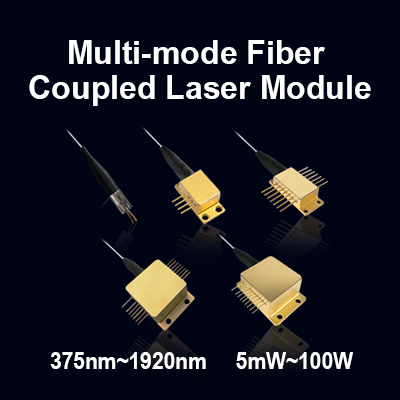
As the power density at the laser facet reaches several megawatts per square centimeter, the semiconductor material begins to absorb its own light. This absorption leads to localized heating, which shrinks the bandgap, leading to more absorption. This thermal runaway results in COMD—a physical melting of the laser mirror. Professional-grade high-power diodes utilize Non-Absorbing Mirror (NAM) technology or specialized facet passivation layers (such as AlN or SiN) deposited in ultra-high vacuum environments. By moving the recombination of carriers away from the surface, we can drive a 940 nm 레이저 다이오드 to higher current densities without the risk of sudden death.
Heat is the primary factor in wavelength drift and power degradation. A standard high-power chip may convert 50% to 60% of electrical energy into light; the remaining 40% is heat that must be removed from a footprint smaller than a grain of salt. The thermal resistance ($R_{th}$) of the submount is critical. Engineers often choose Aluminum Nitride (AlN) or even Synthetic Diamond for submounts due to their high thermal conductivity and Coefficient of Thermal Expansion (CTE) matching with GaAs. If the CTE is mismatched, thermal cycling during operation will introduce mechanical strain into the crystal lattice, creating “Dark Line Defects” (DLDs) that slowly dim the laser over thousands of hours.
In the design of a 고출력 광섬유 결합 레이저 다이오드 module, there are two primary schools of thought: the “Diode Bar” and the “Multi-Single Emitter” (MSE) architecture.
A laser bar consists of multiple emitters grown on a single substrate. While they offer high power in a compact package, they suffer from a mechanical phenomenon known as “Smile.” During the soldering process, the bar may slightly bow (often by only 1-2 micrometers). This curvature makes it impossible to collimated all emitters into a single fiber simultaneously, as each emitter’s fast axis is at a slightly different height. This leads to a degraded BPP and lower coupling efficiency.
Most modern 915nm fiber coupled laser modules for fiber laser pumping now use MSE architecture. In this setup, individual laser chips are mounted on separate heat sinks and their beams are combined spatially or through polarization.
Coupling 200W of power into a 105-micrometer fiber with an NA of 0.22 requires strict adherence to the Law of Etendue. The product of the source size and its divergence angle cannot be reduced by any passive optical system. Therefore, the “bottleneck” is always the entry point of the fiber.
A common mistake in cheaper modules is over-filling the fiber’s NA. While a module might claim to be 0.22 NA, if 95% of the power is concentrated in 0.15 NA, it is a much higher-quality “bright” source than one where the light is spread right to the edge of the 0.22 limit. Light at the very edge of the NA is more likely to escape the core and enter the cladding, especially if the fiber is bent. This “Cladding Power” can melt the fiber jacket or destroy the downstream laser system. High-end high power fiber coupled laser diode modules incorporate “Cladding Power Strippers” or internal baffles to ensure that only the light within the safe NA range leaves the module.
The true value of a 808nm 레이저 다이오드 is found in its “Bathtub Curve” performance—minimizing infant mortality through burn-in and extending the “wear-out” phase through material science.
Historically, Indium solder was used for its flexibility, but it is prone to “Indium Migration,” where the solder physically moves and shorts out the diode over time. Modern high-reliability modules use Gold-Tin (AuSn) hard solder. While harder to process, AuSn provides a much more stable thermal and mechanical interface, which is vital for the 50,000+ hour lifespans required in industrial manufacturing environments.
고객 배경:
An industrial laser manufacturer specializing in sheet metal cutting systems. They were developing a 2kW Continuous Wave (CW) fiber laser and needed reliable pump sources.
기술적 과제:
The customer was experiencing “Pump Failure” in their prototypes. Investigation revealed that the back-reflections from the fiber laser’s active core were re-entering the pump diodes, causing the 915nm chips to overheat and fail. Additionally, the BPP of their previous pumps was too high, forcing them to use 200um fibers, which reduced the overall efficiency of the fiber laser.
기술 매개변수 및 설정:
품질 관리(QC) 솔루션:
Each module was tested using a “Fiber Beam Profiler” to ensure that 95% of the power was contained within an NA of 0.18, providing a safety margin for the customer’s 0.22 NA system. We also implemented a “High-Power Back-Reflection Test” where we intentionally fired a 1064nm laser into the pump’s output fiber to verify the effectiveness of the internal dichroic coating.
결론:
By upgrading to a high-brightness 915nm fiber coupled laser with integrated reflection protection, the customer increased their fiber laser’s optical-to-optical efficiency from 65% to 72%. The use of hard-solder modules eliminated the degradation issues they had seen with Indium-based competitors, and the tighter BPP allowed them to use a smaller-core pump combiner, further improving the beam quality of the final 2kW output.
| 매개변수 | 단위 | 808nm (Medical) | 915nm (Industrial) | 940nm (Pumping) |
| 중심 파장 | nm | 808 ± 3 | 915 ± 5 | 940 ± 10 |
| 출력 전력 | W | 50 – 150 | 100 – 300 | 200 – 450 |
| 광섬유 코어 직경 | μm | 200 / 400 | 105 / 135 | 105 / 200 |
| 수치 개구수 | NA | 0.22 | 0.15 / 0.22 | 0.22 |
| 경사 효율 | W/A | 1.0 – 1.2 | 10.0 – 12.0 (Combined) | 12.0 – 15.0 (Combined) |
| 스펙트럼 폭 | nm | < 4.0 | < 5.0 | < 6.0 |
| Feedback Protection | dB | > 20 (Optional) | > 30 (Dichroic) | > 30 (Dichroic) |
| 납땜 재료 | – | AuSn | AuSn | AuSn |
| 커넥터 유형 | – | SMA905 | Bare Fiber / QBH | Bare Fiber / QBH |
Q1: Why is 915nm and 940nm more popular than 976nm for fiber laser pumping?
While 976nm has a higher absorption cross-section in Ytterbium, it is a very narrow peak. This requires the pump diode to be wavelength-stabilized (using VBG) and the cooling system to be extremely precise. 915nm and 940nm have much broader absorption bands, making the system more “forgiving” to temperature fluctuations and wavelength drift.
Q2: How does the “Cladding Power” affect the life of a laser system?
Cladding power is light that is no longer confined to the fiber core. This light is absorbed by the fiber’s polymer coating, causing it to burn or char. In high-power systems, cladding power is the #1 cause of “Fiber Burn-back.” Professional modules minimize this by ensuring high beam quality (low BPP) at the source.
Q3: What is the benefit of a “Detachable Fiber” vs. a “Permanent Pigtail”?
A permanent pigtail (fixed fiber) offers the lowest possible loss and highest reliability because there is no air-gap or connector interface. Detachable fibers (SMA905 or FC/PC) offer more flexibility for medical applications where fibers are considered consumables, but they are prone to contamination and have lower power thresholds.
Q4: Can these diodes be operated in “Pulsed” mode?
Yes, but with caution. While the diode can be switched quickly, the thermal stress of “On/Off” cycling is much higher than CW operation. If pulsing is required, it is important to ensure the power supply has no current overshoot, as a single microsecond of over-current can cause COMD.
Q5: What is the role of a “Thermistor” in a 300W module?
In a high-power module, the thermistor isn’t just for monitoring; it is a safety interlock. If the cooling water fails or the heatsink becomes detached, the thermistor will detect the rapid temperature rise and signal the driver to shut down before the laser chips melt.
현대의 포토닉스 환경에서 기존의 가스 및 고체 레이저에서 다이렉트 다이오드 시스템으로의 전환은 단순한 트렌드가 아니라 에너지 효율과 시스템 모듈성의 근본적인 변화입니다. 이러한 변화의 핵심은 바로...
상세 정보 보기반도체 광자학의 계층 구조에서 멀티 모드 레이저 다이오드는 원시 에너지 밀도의 정점을 나타냅니다. 단일 모드 이미터는 스펙트럼 순도 및 회절 제한 초점으로 평가받는 광학계의 외과 의사이지만...
상세 정보 보기반도체 레이저의 환경에서 808nm 레이저 다이오드는 산업 제조와 의료 과학 사이의 가장 중요한 교차점을 차지하고 있습니다. 915nm 또는 980nm와 같은 더 높은 파장은 파이버 레이저 펌핑의 필수품이 되었지만, ...
상세 정보 보기산업용 레이저 부문에서 더 높은 출력에 대한 수요는 일정하지만, 출력만으로는 만족할 수 없습니다. 제조업체의 진정한 과제는 단일 이미터에서 고출력 레이저로 확장할 때 공간 밝기를 보존하는 것입니다.
상세 정보 보기