 レーザーダイオードメーカー








ニュース
高品質・高性能・優れたサービス
商品を検索投稿を検索
高品質・高性能・優れたサービス
The evolution of the modern レーザーモジュール begins not with a lens or a housing, but within the crystalline lattice of a direct bandgap semiconductor. To understand why a professional Semiconductor Laser outperforms consumer-grade alternatives, one must look at the carrier recombination dynamics within the active region. Unlike gas or solid-state lasers, the semiconductor variant relies on the injection of electrons and holes into a double-heterostructure or quantum well (QW) design.
When a forward bias is applied to the P-N junction, electrons from the N-side and holes from the P-side flow into the active layer. This layer, typically composed of Gallium Arsenide (GaAs), Indium Phosphide (InP), or Gallium Nitride (GaN), is engineered to have a narrower bandgap than the surrounding cladding layers. This creates a “potential well” that traps carriers, significantly increasing the probability of radiative recombination.
Stimulated emission occurs when a photon with energy precisely matching the bandgap $E_g = h\nu$ triggers an electron to drop from the conduction band to the valence band, emitting a second photon that is coherent in phase, frequency, and direction. In a high-end レーザーモジュール, the precision of this bandgap engineering determines the spectral linewidth and the temperature stability of the output.
The optical feedback required for laser oscillation is provided by the cleaved facets of the semiconductor crystal itself, forming a Fabry-Pérot cavity. However, the high power densities at these facets—often reaching Megawatts per square centimeter—necessitate advanced passivation techniques. Without proprietary facet coatings, a laser for sale in the industrial market would succumb to Catastrophic Optical Damage (COD) within hours of operation.
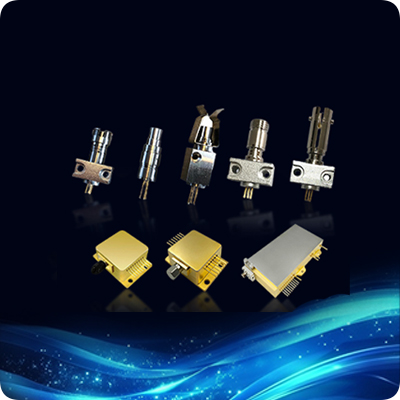
A レーザーモジュール is far more than a diode in a tube. It is a complex optomechanical system designed to manage heat, stabilize current, and shape the highly divergent raw beam of a Semiconductor Laser. In technical procurement, the terms レーザーモジュール, laser modul, or the occasionally used Latinate laser modulo all refer to this integrated solution.
の生の出力 レーザーダイオード is inherently asymmetric. Due to the narrow dimensions of the emitting aperture (often only 1 micrometer high), diffraction causes the beam to diverge rapidly—a phenomenon known as the “Fast Axis” and “Slow Axis” divergence.
高性能 レーザーモジュール utilizes aspheric glass lenses to correct this. For multi-mode emitters used in high-power applications, Fast-Axis Collimation (FAC) lenses are micro-optics glued directly onto the diode submount with micron-level precision. The choice of optical material—whether it is high-refractive-index N-SF11 glass or molded plastic—dictates the beam’s M² factor (beam quality) and long-term power stability.
効率の Semiconductor Laser typically ranges from 30% to 60%. The remaining energy is converted into heat. Because the wavelength of a laser diode shifts with temperature (typically 0.3nm/°C for GaAs), maintaining a constant junction temperature is critical.
Industrial レーザーモジュール utilize copper submounts with high thermal conductivity and, in many cases, integrated Thermoelectric Coolers (TEC). By monitoring a built-in Negative Temperature Coefficient (NTC) thermistor, the driver circuit can dynamically adjust the TEC current to maintain sub-degree temperature stability. This is the technical differentiator between a generic component and a professional-grade module.
When an engineer searches for a laser for sale, the “unit price” is often a deceptive metric. The true cost of a laser system is dictated by the Mean Time To Failure (MTTF) and the integration overhead. A lower-tier Semiconductor Laser may save $50 initially, but if its beam pointing stability causes a failure in a medical surgical robot or a LIDAR sensor, the warranty and reputation costs can reach five figures.
If a レーザーモジュール uses low-quality optics, the beam divergence will increase over time due to thermal expansion or lens degasification. In industrial cutting or medical ablation, this leads to a larger spot size, lower energy density, and ultimately, a failed process. The “System Cost” includes the replacement labor and the downtime of the end-user’s facility.
The PN junction of a レーザーモジュール is extremely sensitive to electrostatic discharge (ESD) and current spikes. A robust module incorporates a “Soft Start” circuit and Transient Voltage Suppressors (TVS). If an OEM chooses a cheap laser modul lacking these protections, the “Infant Mortality” rate of their products will rise, leading to a disastrous cycle of field repairs.
To provide a clear picture of the engineering gap, the following table compares the typical parameters of an industrial-grade レーザーモジュール (optimized for durability) against a standard consumer-grade unit.
| 技術パラメーター | Industrial Grade (laserdiode-ld.com standard) | Consumer/Hobbyist Grade |
| 波長許容差 | ±3 nm (customizable to ±1 nm) | ±10 nm to ±20 nm |
| Operating Life (MTTF) | 10,000 to 20,000 hours | < 3,000 hours |
| Beam Divergence (Full Angle) | < 0.5 mrad (with collimation) | 1.5 – 3.0 mrad |
| 熱管理 | Active TEC / Copper Heatsink | Passive Aluminum / No Heatsink |
| Optical Coating | High-Damage Threshold AR Coating | Standard Grade or Uncoated |
| Power Stability (8h) | < 1% RMS | > 5% – 10% |
| Driver Protection | ESD, Over-temp, Reverse Polarity | Basic Current Limiting |
Beyond the core keywords, three critical technical domains must be addressed to fully understand the current state of Semiconductor Laser technology:
A European manufacturer of dental surgical equipment required a high-reliability レーザーモジュール for soft-tissue ablation. The device needed to be handheld, battery-operated, and capable of constant power output for 15-minute procedures without overheating.
Each レーザーモジュール underwent a 48-hour “Burn-in” test at 40°C to weed out early-life failures. Spectral testing was performed using a high-resolution spectrometer to ensure no mode-hopping occurred under varying current levels. The beam profile was mapped using a CCD camera to verify the absence of “hot spots” that could burn tissue unevenly.
By selecting a high-spec Semiconductor Laser with integrated monitoring, the client reduced their assembly time by 30%—as they no longer needed to calibrate external optics. The field failure rate dropped from 4.5% (with their previous supplier) to less than 0.2% over a two-year period. This transition proved that the upfront cost of a superior レーザーモジュール is recovered through reduced warranty claims.
In a globalized market, the search for a laser for sale often leads to marketplaces flooded with unverified specifications. For an OEM, the vetting process must focus on the following engineering data:
The technical superiority of レーザーモジュール from dedicated manufacturers like レーザーダイオード-LD.com lies in the mastery of these micro-details. Whether the term used is laser modul or レーザーモジュール, the underlying requirement remains the same: the reliable conversion of electrons into precise photons.
Q1: What is the main cause of sudden failure in a Semiconductor Laser module?
A: Most sudden failures are caused by Electrostatic Discharge (ESD) or Catastrophic Optical Damage (COD). COD occurs when the power density at the facet is so high that the semiconductor material melts, often triggered by a current spike or a speck of dust on the facet.
Q2: How does the “Fast Axis” collimation affect the quality of a laser module?
A: Because the emitting area is so thin, the beam diverges very quickly in one direction (the Fast Axis). If the FAC lens is not aligned within sub-micron tolerances, the resulting beam will be astigmatic, making it impossible to focus the laser into a small, clean spot.
Q3: Why are some laser modules significantly more expensive even if they have the same power rating?
A: The price difference usually reflects the quality of the internal diode “binning” (selecting only the most stable diodes), the complexity of the driver circuit (protection and stability), and the precision of the optical collimation. Higher-priced modules offer lower M² values and longer lifetimes.
Q4: Can a laser module’s wavelength be adjusted?
A: To a limited extent, yes. By changing the operating temperature via a TEC, the wavelength can be shifted slightly (approx. 0.3nm per degree Celsius). This is commonly used in “tuning” the laser to a specific absorption peak of a gas or a solid-state gain medium.
一般の人々にとって、レーザーダイオードはバーコードスキャナーやDVDプレーヤーの光源として認識されている。しかし、医療診断という高リスクの世界では、この微小な半導体は精密さの要、静粛性の源へと進化を遂げている。.
詳細を見る現代のウェアラブル機器(スマートウォッチ、ARグラス、TWSイヤホン)の組み立てにおいて、接着剤と超音波溶着は段階的に廃止されつつある。接着剤は硬化速度が遅すぎ、超音波振動は精密なMEMSマイクやジャイロスコープを破壊する。標準となるのは...
詳細を見る歯科用ダイオードレーザーにより、大規模な外科的フラップ手術を伴わずに進行性歯周炎を治療することは可能か? 歯科用ダイオードレーザーが患者ケアと臨床転帰の改善に及ぼす有効性に関する疑問を決定的に解明するためには...
詳細を見る産業用製造の競争環境において、生レーザーダイオードから機能的なレーザーモジュールへの移行は、しばしば誤解されている。多くの調達担当者は「なぜレーザーのビーム品質が経時劣化するのか?」あるいは「なぜ...
詳細を見る