 Fabricante de diodos láser










NOTICIAS
Alta calidad, alto rendimiento, excelente servicio.
Buscar productoBuscar publicación
Alta calidad, alto rendimiento, excelente servicio.
In high-stakes industrial environments—from aerospace marking to medical device manufacturing—the choice of a light source often dictates the uptime of the entire assembly line. The diodo láser acoplado a fibra has emerged as the preferred solution for system integrators.
Sin embargo, antes de preguntar por qué your current laser source is degrading or requiring frequent calibration, we must ask: Is the laser architecture isolated from the mechanical stresses of the work environment? If your laser source is directly mounted to a moving gantry without fiber isolation, you are likely fighting a losing battle against vibration and thermal flux.
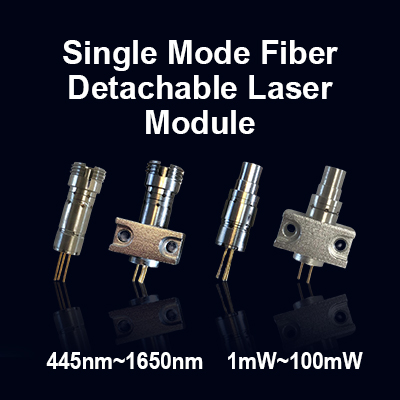
A módulo láser de fibra (specifically a diode-based one) serves as a bridge between high-power semiconductor technology and precision mechanical delivery. By transitioning the output of a módulo láser de diodo into a flexible optical fiber, we achieve “Total Decoupling.
| Parámetro | Standard Diode Laser Module | Láser acoplado por fibra |
| Output Profile | Rectangular/Elliptical | Circular (Top-Hat) |
| Cooling Requirement | At the point of use | Remote (Chiller-based) |
| Vibration Tolerance | Moderate (Lens sensitive) | High (Fiber is flexible) |
| Alignment Complexity | High (Requires 6-axis control) | Low (Plug-and-play connectors) |
| Wavelength Precision | Dependent on local airflow | Highly stable (Isolated) |
When selecting a fiber coupled laser diode, the core diameter is the most significant factor in determining the “brightness” of your system.
Is a smaller fiber core always better?
While a $50\mu m$ core allows for a tighter focus, it also increases the power density at the fiber facet to extreme levels. For high-power industrial cutting, a $105\mu m$ or $200\mu m$ core is often the “sweet spot,” providing enough energy for the task while ensuring the fiber laser module survives for its full 20,000-hour rated lifespan.
Contexto industrial: Precision Medical Device Fabrication.
El escenario: A manufacturer of nitinol medical stents was using a direct-diode system for precision micro-welding. They were struggling with “bead inconsistency.” Every time the room’s HVAC system kicked on, the slight change in ambient temperature caused the módulo láser de diodo to shift its beam pointing by just a few microns—enough to ruin a $5,000 medical part.
La investigación “Pregunta si es así”:
We asked: Is the diode itself unstable, or is the thermal expansion of the aluminum mounting bracket causing the drift?
Our testing confirmed that the diode was fine, but the physical mount was “breathing” with the room temperature.
La solución:
We transitioned them to a 976nm fiber coupled laser sistema.
El resultado:
The point where the fiber meets the acoplado por fibra diodo láser is the most vulnerable part of the system.
One of the most exciting developments in 2025 is the ability to couple 450nm (Blue) light into fibers with high efficiency. For the first time, we are seeing láser acoplado por fibra units capable of welding gold and pure copper in the jewelry and electronics sectors with a precision that was previously only possible with expensive Green lasers or high-maintenance UV systems.
The decision to use a módulo láser de fibra is a decision to invest in system-level stability. While the initial cost of a diodo láser acoplado a fibra may be higher than a bare diode, the reduction in maintenance, the ease of integration, and the superior beam quality provide a much lower Total Cost of Ownership (TCO) over the life of the project.
La industria moderna depende cada vez más de la precisión de la luz. En la jerarquía de la fotónica, el diodo láser acoplado a fibra es la cumbre de la integración optoelectromecánica. A diferencia de los diodos de emisión direct...
Ver detallesIntroducción: Más allá de la ficha técnica En el competitivo panorama de la fabricación de dispositivos médicos, la diferencia entre un dispositivo "de referencia" y un producto retirado del mercado suele residir en la selección de los componentes. Concretamente, en la fuente de luz. Cuando los ingenieros...
Ver detallesEn el vertiginoso mundo del procesamiento industrial, la frase "el tiempo es oro" es literal. Los fabricantes suelen buscar actualizar su módulo láser de diodo a una potencia superior para aumentar la velocidad de producción. Sin embargo, antes de preguntarse por qué un láser de 100 W no es...
Ver detallesLa rápida expansión de la fotónica industrial ha impulsado la demanda de soluciones láser estables, de alto rendimiento y miniaturizadas. Entre ellas, el módulo de diodo láser se ha convertido en un componente fundamental en la detección, la alineación, la espectroscopia, la comunicación...
Ver detalles