 Laser Diode Manufacturer











NEWS
High quality high performance excellent service
Search productSearch post
High quality high performance excellent service
When an engineer seeks to buy laser diodes, the immediate focus is often on peak power and wavelength. However, the true metric of a high-performance diode laser is its degradation rate under high-injection conditions. Understanding the physics of failure is the only way to evaluate if a laser diode price is a bargain or a liability.
The primary enemy of the laser diode laser is the propagation of non-radiative recombination centers, specifically Dark Line Defects (DLDs). These defects are essentially dislocations in the crystal lattice that grow under the influence of intense photon density and thermal stress. From an engineering standpoint, the growth rate of these defects follows the Arrhenius equation:
$$R = A \cdot J^n \cdot \exp\left(-\frac{E_a}{k_B T_j}\right)$$
Where $R$ is the degradation rate, $J$ is the current density, $E_a$ is the activation energy, and $T_j$ is the junction temperature. A manufacturer that masters the epitaxy process reduces the initial “seed” dislocations, effectively increasing the $E_a$ and extending the Mean Time to Failure (MTTF). This is the technical reality behind the price disparity in the market. When you ask where can you buy diodes that last 20,000 hours versus 2,000 hours, you are essentially asking who has the most pristine crystal growth and cleanest facet passivation.
For many industrial applications, a standard laser diode provides a broad spectral envelope (typically 3-5nm FWHM). However, in fields like Solid-State Laser pumping or gas sensing, this is insufficient. To achieve a narrower linewidth, engineers must move beyond the simple Fabry-Pérot cavity.
Distributed Feedback (DFB) and Distributed Bragg Reflector (DBR) architectures integrate a diffraction grating directly into the semiconductor layers. This grating acts as a highly selective filter, allowing only a single longitudinal mode to oscillate. This level of precision requires electron-beam lithography or interference lithography, significantly adding to the laser diode price.
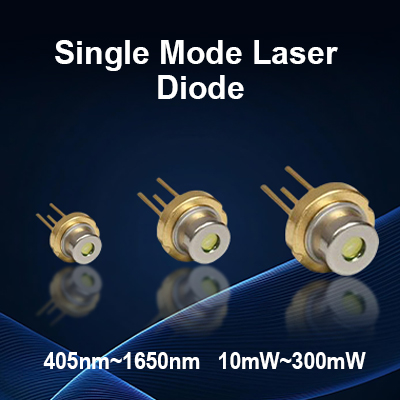
Alternatively, External Cavity Laser Diodes (ECLD) utilize a Volume Holographic Grating (VHG) to provide external feedback. This approach allows for ultra-narrow linewidths (<100 kHz) and excellent wavelength stability over temperature ($\frac{d\lambda}{dT} \approx 0.01 \text{ nm/°C}$). For procurement specialists, knowing whether a system requires internal grating or external stabilization is vital before making a laser diode buy decision.
A fundamental characteristic of the diode laser is its inherent astigmatism. Due to the rectangular geometry of the emitting aperture (often $1 \mu m \times 100 \mu m$ for broad-area emitters), the beam diverges at different rates. The “Fast Axis” (perpendicular to the junction) can have a divergence angle of $30^\circ$ to $40^\circ$, while the “Slow Axis” is typically $6^\circ$ to $10^\circ$.
Managing this Beam Parameter Product (BPP) is where high-end manufacturers differentiate themselves. Fast Axis Collimation (FAC) lenses—often micro-aspheric cylindrical lenses made of high-refractive-index glass—must be aligned with sub-micron precision. A misalignment of even 500nm can lead to a significant loss in brightness. This precision assembly is a major component of the manufacturing overhead. High-quality laser diode modules include these optics pre-aligned, which simplifies the integration for the end-user but increases the unit cost.
The efficiency of a laser diode laser is typically expressed as Wall-Plug Efficiency (WPE), the ratio of optical output power to electrical input power. While high-power GaAs diodes can achieve WPEs of over 60%, the remaining 40% is converted into heat.
This heat must be removed from a tiny volume. The thermal impedance ($Z_{th}$) of the package is the critical bottleneck. Using high-conductivity submounts, such as Aluminum Nitride (AlN) or Diamond, allows for more efficient heat extraction. For engineers comparing laser diode price points, it is essential to look at the thermal resistance specifications. A diode with a lower $R_{th}$ can be driven harder and will exhibit less wavelength “chirp” during pulsed operation, providing a more stable source for precision manufacturing.
The following data table illustrates the typical impact of junction temperature ($T_j$) on the expected lifetime and wavelength stability of an 808nm AlGaAs diode laser. This demonstrates why thermal management is as important as the diode itself.
| Junction Temperature (Tj) | Expected MTTF (Hours) | Wavelength Shift (Δλ) | Wall-Plug Efficiency (WPE) | Failure Mode Probability |
| 25°C | 30,000+ | 0.0 nm (Ref) | 62% | <0.01% (Infant) |
| 45°C | 12,000 | +5.6 nm | 55% | 0.5% (Degradation) |
| 65°C | 4,500 | +11.2 nm | 48% | 2.1% (DLD Growth) |
| 85°C | 1,200 | +16.8 nm | 39% | 8.5% (Facet Melting) |
| 105°C | <200 | +22.4 nm | 28% | >25% (Catastrophic) |
Client Background:
An automotive tier-1 supplier required a 915nm laser diode solution for automated plastic welding of taillight assemblies. The process required a highly uniform “top-hat” beam profile to ensure consistent melt depth across a 200mm seam.
Technical Challenges:
The primary issue was “hot spots” in the beam profile caused by poor spatial mode quality in the diodes they previously sourced. These hot spots caused localized burning of the polymer, leading to a 15% rejection rate. Furthermore, the 24/7 duty cycle of the assembly line meant that any diode failure resulted in significant production downtime.
Technical Parameters & Settings:
Quality Control (QC) & Engineering Solution:
We transitioned the client to a multi-bar stack module utilizing hard-solder (AuSn) construction to prevent thermal creep. We implemented a secondary homogenization optic that mixed the modes from multiple emitters, effectively smoothing out the spatial irregularities. Each module underwent a 48-hour high-stress burn-in at 1.2x the rated current to filter out potential DLD-prone units.
Conclusion:
The implementation of the high-reliability diode laser module reduced the weld rejection rate from 15% to 0.05%. By investing in a higher-tier laser diode buy, the client achieved a payback period of just 4 months through reduced material waste and increased uptime. This case proves that where can you buy diodes is a strategic decision that impacts the entire manufacturing yield.
When a company enters the market to buy laser diodes, they face a choice: buy the raw TO-can/chip and handle the optics/cooling internally, or buy a fully integrated, fiber-coupled module. For low-volume prototyping, the raw component might seem attractive due to the lower laser diode price. However, the hidden costs of mounting, alignment, and specialized driver circuitry often exceed the cost of a pre-engineered module.
Industrial reliability is built on the foundation of cleanroom standards and material science. Whether the application is metal 3D printing, medical aesthetics, or defense-grade LiDAR, the performance of the laser diode laser is the ceiling for the entire system’s capability.
Q: How does the “Wall-Plug Efficiency” (WPE) affect the total system cost?
A: Higher WPE means less waste heat. This directly reduces the size and cost of the cooling system (chillers, fans, heat sinks) and lowers the electricity consumption over the machine’s lifespan. In high-power installations, a 10% increase in WPE can save thousands of dollars in operational costs.
Q: Why is “Hard Solder” (AuSn) preferred over “Soft Solder” (Indium) in high-power diodes?
A: Indium is susceptible to “thermal creep” and “electromigration,” which can cause the solder to move and short out the diode or shift the chip’s alignment over time. AuSn (Gold-Tin) is a hard solder that remains stable under high thermal cycling, ensuring long-term mechanical and optical stability.
Q: What is the significance of the “Fast Axis Collimator” (FAC) in fiber coupling?
A: The FAC is the first lens the light hits after leaving the diode. Because the fast axis divergence is so high, the FAC must capture the light immediately to prevent loss. The quality of this lens determines how much power can be efficiently launched into a small-core fiber.
Q: Does the laser diode price include the driver?
A: Typically, no. In the professional market, the laser diode and the laser driver are sold separately because the driver must be tailored to the specific modulation and pulse requirements of the application. However, some “smart” modules now include integrated drivers for plug-and-play functionality.
The spectral region surrounding 635 nanometers represents a critical technical threshold in the visible light spectrum. While 650nm and 660nm diodes are ubiquitous in consumer electronics, the 635nm laser diode operates closer to the peak sensitiv...
View detailsIn the industrial laser sector, the demand for higher power is constant, yet power alone is a deceptive metric. The true challenge for a manufacturer is the preservation of spatial brightness when scaling from a single-emitter to a high-power mult...
View detailsTo understand the operational excellence of a modern laser diode, one must look beyond the macroscopic housing and into the microscopic architecture of the semiconductor heterostructure. At its core, the laser diode is a triumph of quantum mechani...
View detailsIn the field of high-power semiconductor photonics, the Broad Area Laser Diode (BALD) stands as the primary vehicle for high-energy photon generation. While the general terminology often alternates between diodelaser, diodlaser, and the phonetic v...
View details