 웨이브스펙트럼 그룹


NEWS
고품질 고성능 우수한 서비스
제품 검색게시물 검색
고품질 고성능 우수한 서비스
Across scientific labs, medical device companies, and industrial measurement systems, the laser diode module remains one of the most critical optical subsystems. Demand has shifted from simple illumination tools to highly regulated, thermally optimized, low-noise systems capable of stable wavelength output over months of continuous operation.
As experimental sensitivity increases, uncontrolled thermal drift and driver instability are no longer acceptable. A tightly integrated laser diode and driver configuration is now mandatory in OEM equipment, especially where nanometer-level wavelength stability or highly consistent beam intensity is required. Meanwhile, the infrared laser module has become essential in biomedical spectroscopy, NIR imaging, and long-distance optoelectronic instrumentation.
This article provides a technical review of the design, function, and use cases of these systems, followed by a scientific case study from Munich, Germany, in December 2023.
The diode chip’s epitaxy determines:
High-precision modules often use MOCVD-grown layers with <1% variation across wafers.
Most diodes exhibit asymmetric beam divergence.
Modules use:
These ensure consistent beam profile in spectroscopy and medical devices.
A well-designed laser diode module uses:
The laser diode and driver combination can be seen as a single electro-optic engine. The driver determines whether the diode will operate within its ideal range or drift into thermal runaway.
In long-distance NIR systems, driver stability directly affects SNR (signal-to-noise ratio).
An infrared laser module is strongly favored in:
IR wavelengths minimize absorption in water and lipids, making them ideal for non-invasive biomedical monitoring.
Modules at 785 nm or 808 nm are used to excite molecular vibrations while avoiding fluorescence noise.
1050 nm and 1310 nm IR modules:
Laser modules act as alignment references when components require sub-millimeter placement.
IR modules detect gas absorption lines, enabling:
OEM integrators require:
Noise-suppressed laser diode and driver systems maintain:
Laser diode modules must endure:
Modules using gold-bond wire and sealed housings provide the highest lifetime.
“Infrared Spectroscopy Calibration Project — Munich Institute for Biomedical Optics”
In December 2023, researchers at the Munich Institute for Biomedical Optics conducted a calibration upgrade on their Raman spectroscopy platform. The lab required a stable near-infrared excitation source to analyze minute metabolic changes in tissue samples.
The older 785 nm diode system drifted by nearly 2 nm after 30 minutes of operation. This caused spectral shifting that corrupted biochemical fingerprinting results.
The engineering team replaced the outdated unit with a next-generation 785 nm infrared laser module, paired with a precision low-noise laser diode and driver set featuring:
The upgrade dramatically stabilized the excitation line.
Dr. Roth later reported that the new IR module made it possible to publish higher-resolution Raman datasets in early 2024.
High-quality laser diode modules are more than illumination tools—they are critical precision components that drive modern scientific, industrial, and medical instrumentation. When correctly paired with a stable laser diode and driver, and especially when configured as an infrared laser module, they provide unmatched wavelength stability and operational reliability. The Munich case study reinforces how critically these systems influence research accuracy and real-world performance.
The rapid expansion of industrial photonics has pushed the demand for stable, high-output, and miniaturized laser solutions. Among these, the laser diode module has become a foundational component in sensing, alignment, spectroscopy, communicati...
상세 정보 보기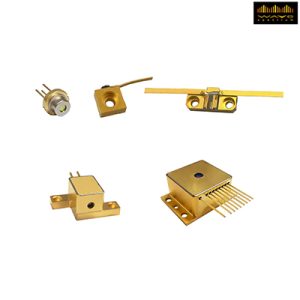
다중 모드 레이저 다이오드는 다양한 산업 분야에서 폭넓게 활용되는 다목적 부품입니다. 주요 적용 분야는 다음과 같습니다: 광통신 시스템 이 다이오드는 광섬유 통신에서 효율적인 광원으로 사용되며, ...
상세 정보 보기The rapid expansion of industrial photonics has pushed the demand for stable, high-output, and miniaturized laser solutions. Among these, the laser diode module has become a foundational component in sensing, alignment, spectroscopy, communicati...
상세 정보 보기