 GRUPPO WAVESPECTRUM


NEWS
Alta qualità, prestazioni eccellenti, servizio eccellente
Cerca prodottoCerca post
Alta qualità, prestazioni eccellenti, servizio eccellente
The rapid expansion of industrial photonics has pushed the demand for stable, high-output, and miniaturized laser solutions. Among these, the laser diode module has become a foundational component in sensing, alignment, spectroscopy, communication, and medical-device manufacturing. Its compact footprint, optical efficiency, and predictable behavior make it essential for OEM integrators and research laboratories.
With more industries requiring tighter optical tolerances and better thermal stability, the role of the laser diode and driver pair has become increasingly important. A diode’s optical waveform is only as stable as the current regulation behind it. Likewise, modern systems often rely on an infrared laser module for long-range detection, non-contact measurement, fiber coupling, and material-processing tasks where invisible beams reduce user distraction.
This article provides an in-depth look into design parameters, output stability, thermal engineering principles, and deployment considerations. It concludes with a real-world industrial case study from 2024 involving a manufacturing line in Osaka, Japan.
Although laser diode modules are small, their internal structure is engineered for precision. A typical laser diode module incorporates:
Here the laser diode and driver interaction becomes critical. A laser diode requires:
A poorly regulated driver causes mode hopping, wavelength shifting, and early diode failure.
Thermal management determines beam stability over long duty cycles.
An infrared laser module (IR module) operates in the 700–1700 nm region and brings major advantages:
Industries heavily dependent on IR modules include:
Laser diode modules act as triggers for:
IR modules (980 nm / 1064 nm / 1470 nm / 1550 nm) power:
Line lasers, cross lasers, and dot lasers facilitate:
Paired with precision drivers, fiber-coupled IR modules ensure stability over long distances and fluctuating temperatures.
The laser diode and driver must be matched:
Drivers with PID temperature loops are essential for IR modules that drift easily under heat.
When choosing a laser diode module, integrators evaluate:
Modules operating in >50% duty cycles require:
“Infrared Laser Module Integration for Automated Syringe Inspection — Osaka, Japan”
In July 2024, Takamura Medical Systems, an OEM automation provider located in Osaka, upgraded its syringe inspection line for a pharmaceutical client. The old camera-only system struggled with micro-crack detection due to reflection issues on transparent polymer syringes.
Polymer syringe barrels refracted visible light erratically. Camera contrast fluctuated, causing detection errors.
The team selected a 980 nm infrared laser module paired with a precision laser diode and driver set.
Advantages:
This case became a reference model for multiple factories across Kansai in 2024–2025.
Laser diode modules continue to expand into high-precision sectors. When paired with the correct laser diode and driver, both visible and infrared laser module systems deliver predictable, long-lasting optical output essential for industrial automation. The Osaka case study demonstrates how IR modules improve manufacturing accuracy and operational efficiency, providing a real benchmark for OEM integrators.
Across scientific labs, medical device companies, and industrial measurement systems, the laser diode module remains one of the most critical optical subsystems. Demand has shifted from simple illumination tools to highly regulated, thermally op...
Visualizza dettagli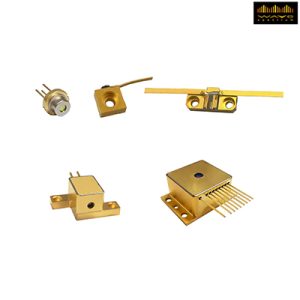
I diodi laser multimodali sono componenti versatili con un'ampia gamma di utilizzi in vari settori industriali. Le principali aree di applicazione includono: Sistemi di comunicazione ottica Questi diodi fungono da efficienti sorgenti luminose nelle comunicazioni in fibra ottica, consentendo...
Visualizza dettagliAcross scientific labs, medical device companies, and industrial measurement systems, the laser diode module remains one of the most critical optical subsystems. Demand has shifted from simple illumination tools to highly regulated, thermally op...
Visualizza dettagli